
Pop Culture Shifts, We Feel It

Recently I came across a piece of music news that really stuck with me:
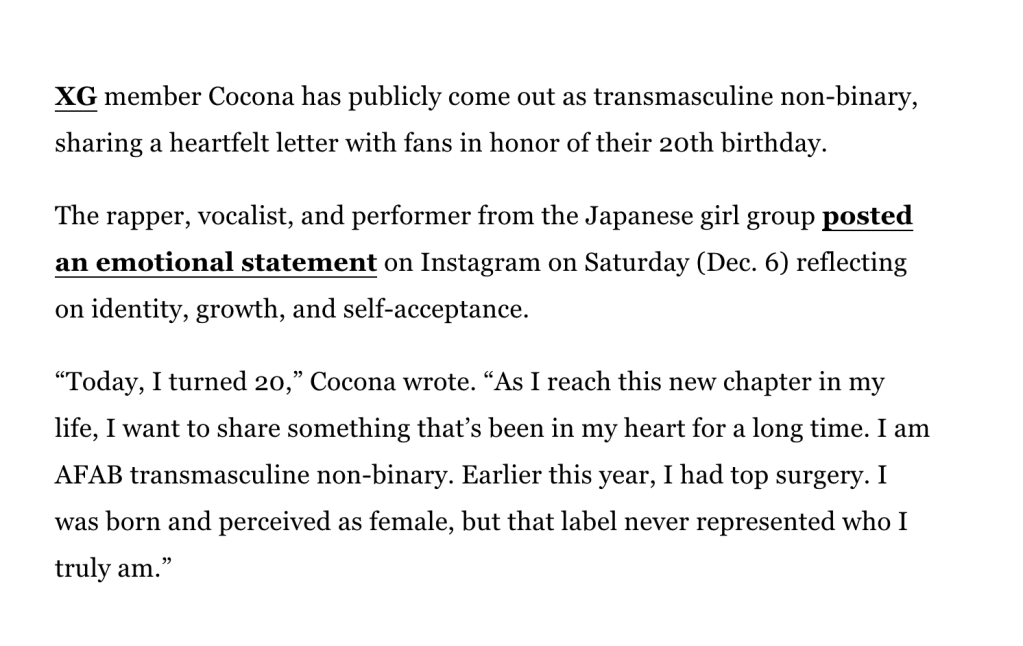
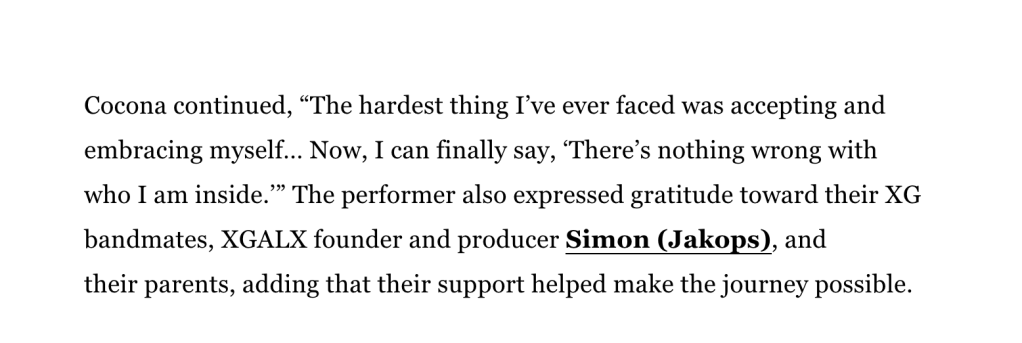
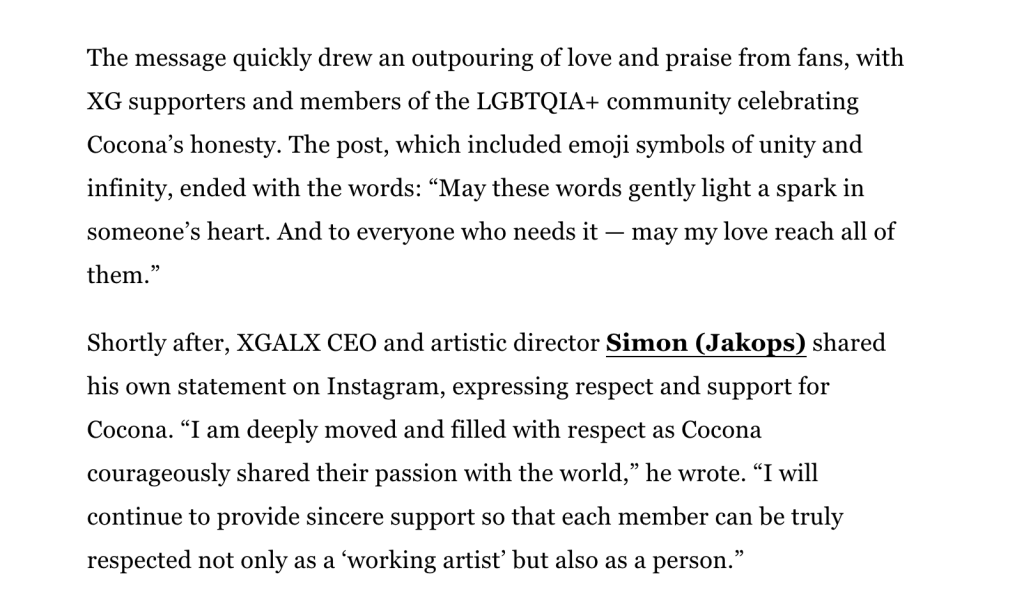
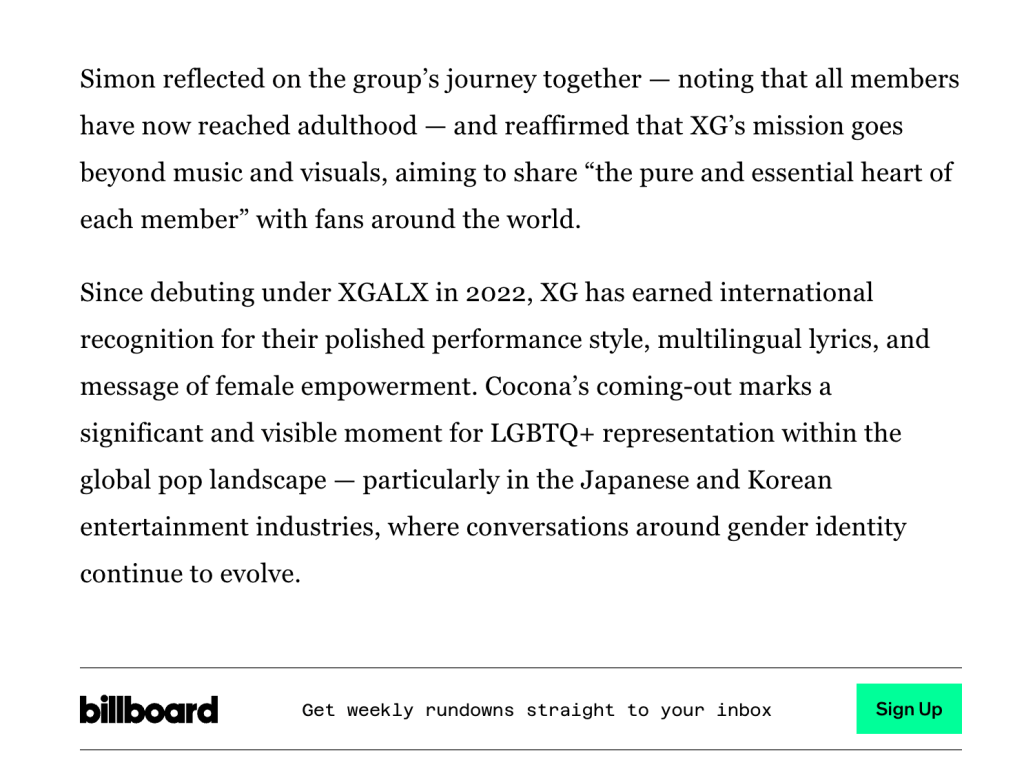
XG’s Cocona Comes Out as Transmasculine Non-Binary On 20th Birthday
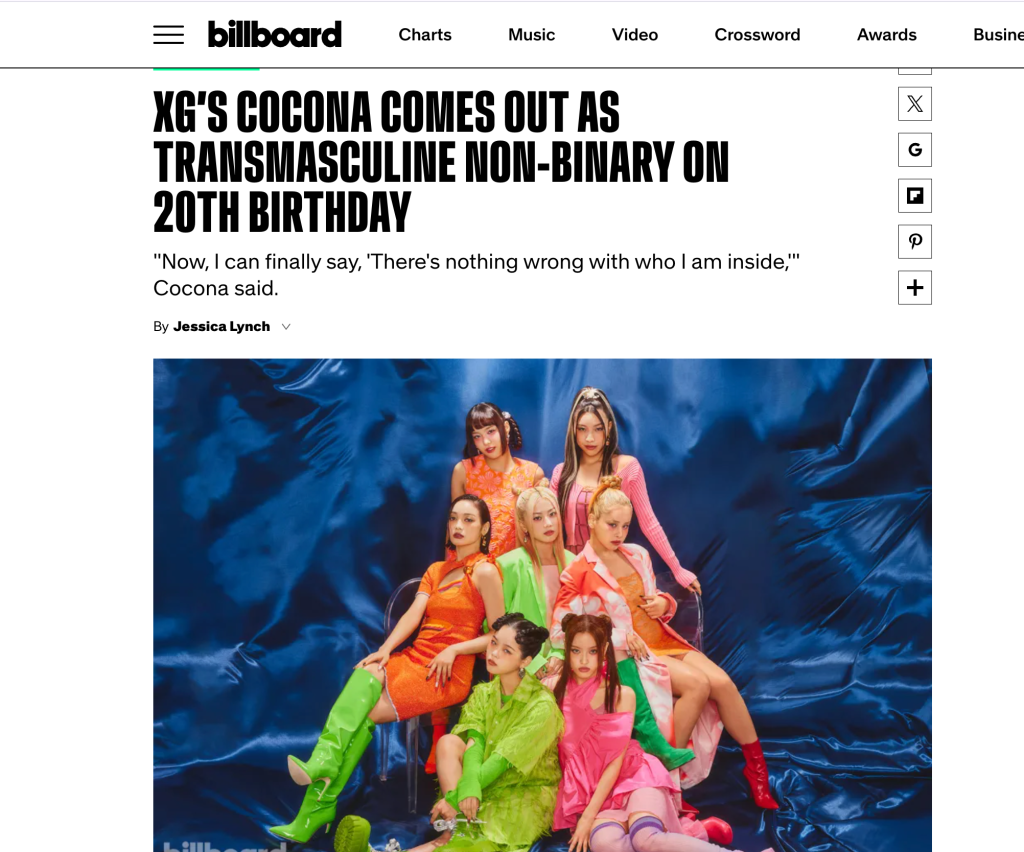
Screen shot of the news from Billboard


And unsurprisingly, it sparked a huge wave of attention and discussion. Why?

First, a quick intro: XG is a Japan-based global girl group that debuted in 2022.

In the East Asia entertainment industries — which are still very conservative in terms of gender norms — publicly coming out as non-binary or trans is extremely rare, almost unheard of. For Cocona to share their truth at such a symbolic moment (turning 20!) is genuinely brave. Amid the pressure, the spotlight, and the expectations placed on young artists, they still chose to say This is who I am.

That’s exactly why Cocona’s announcement feels so significant.
And honestly? I think it’s a good sign.

Their announcement brings new visibility to LGBTQ+ identities in Asian pop culture. In the idol world, people tend to assume everyone must fit the “traditional beauty” mold — perfect hair, perfect makeup, perfectly feminine. There’s barely any space for gender diversity, and public conversations about non-binary identities in Asia are almost nonexistent.


Cocona’s choice helps more fans — especially young people — see that identities outside the binary do exist in Asia, and they deserve to be seen.

This is something worth recording and talking about.
It shows an industry slowly shifting, and it pushes us to think about a bigger question: How can we build a pop culture landscape that’s more inclusive, more diverse, and more reflective of the world we actually live in?


Comments

3 responses to “Pop Culture Shifts, We Feel It”

  1. Hi Layla, thank you for sharing this news. I actually saw the original post on Instagram that day, and I remember almost every comment being supportive and heartwarming. I think Cocona’s story is a big step for representation, and I’m so glad you shared it.

    Like

  2. As a follower of XG, this news feels both complex and conflicting to me. On one hand, I understand and respect the real pain Cocona may experience in a very conservative East Asian entertainment industry, where bodies and gender expression are strictly controlled and constantly watched by the public. Choosing to openly share her identity and accept the possible social consequences requires courage, and that deserves to be taken seriously.

    On the other hand, I find it hard to fully agree with the logic behind this decision. From both neuroscience and life experience, people under the age of 25 are still strongly shaped by their environment, and many life-changing decisions are deeply influenced by culture, social pressure, and industry structures. In addition, if “being more like a man” is understood as removing breasts, and “being more like a woman” as wearing long hair, skirts, and high heels, this may unintentionally reinforce gender stereotypes rather than challenge them.

    On a personal level, I respect her choice and her willingness to take responsibility for it. However, as a consumer and cultural participant, when a group built around the idea of “girls’ power” includes a member who does not want to be identified within that category, it makes me rethink whether I still want to support the group as a whole. For me, the importance of this moment is not about simple support or rejection, but about pushing us to more carefully and responsibly discuss the relationship between gender freedom, personal choice, commercial narratives, and stereotypes.

    Like

  3. I wasn’t familiar with this group before, but I agree that stereotypes are worth questioning. At the same time, treating physical traits like breasts as a stand-in for gender or femininity feels like it risks reinforcing the very binaries the discussion is trying to critique.

    Like

Leave a reply to Yu Zhou Cancel reply